Daily Archives: March 5, 2009

Fact checking, National Post style: Lorne Gunter on global cooling (part 1)

In the wake of the kerfuffle concerning George Will’s column on sea ice in the Washington Post, Lorne Gunter has upped the ante in the Canadian daily newspaper National Post with a particularly error-ridden and nonsensical column on a favourite theme – the supposed “intellectual dishonesty” of climate scientists who refuse to accept the “fact” of “global cooling”.

A key issue in the Will case was the apparent failure of fact checkers and editors to catch what should have been obvious errors. Like Will, Gunter appears to lean on tidbits from such reliable sources as U.S. senator James Inhofe’s climate disinformation clearing house (run by aide Marc Morano), or blogs like Stephen Mcintyre’s Climateaudit.org or Anthony Watt’s Wattsupwiththat.com. Gunter then proceeds to somehow mangle even those dubious assertions.
Continue reading

Seasonal divergence in tropospheric temperature trends

msu-tlt-tropical-peak

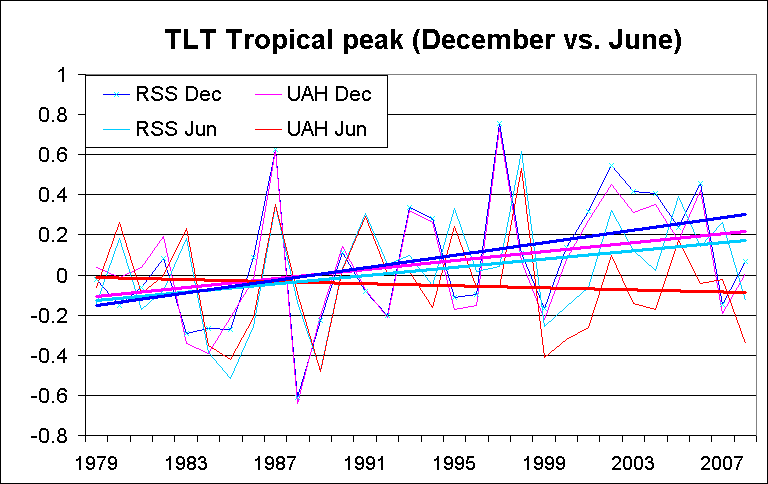
The two most commonly cited estimates of temperature in the troposphere based on satellite data are provided on an ongoing basis by Remote Sensing Systems (RSS) and University of Alabama at Huntsville (UAH). Last year, a strong annual cycle was identified in the UAH data by Atmoz and was examined in detail by Tamino at Open Mind here and here. In UAH, the annual cycle results in significantly higher anomalies at the beginning of the year (northern hemisphere winter) than in the middle of the year. And this pattern appears to be present in all latitude zones.

It seems reasonable that such a cycle would affect the observed trends over the 30-year period of the satellite temperature record. And indeed, it turns out there is a strong seasonal divergence; UAH trends for June-July-August (NH summer or JJA) are markedly lower than for December-January-February (NH winter or DJF). This strong seasonal divergence can be seen not only globally, but even in the tropics, as shown in detail below. This suggests that UAH trends lack physical realism, and should not be relied upon until the source of annual cycle problem is identified and fixed.

Continue reading