Category Archives: Climate science disinformation

Ethical Oil political connections, part 1: Conservatives “Go Newclear”

As a once in a generation Canadian pipeline review process gets underway, the rhetoric around the massive Northern Gateway project has heated up noticeably. The Conservative government and the Ethical Oil pro-industry group seemed to take turns ratcheting up attacks on environmental groups opposing the project almost daily. Natural Resources Minister Joe Oliver may have set a new low in his recent attacks on those who would  “hijack our regulatory system to achieve their radical ideological agenda”, backed by “foreign special interest groups”, not to mention “billionaire socialists … like George Soros”. The eerie echoes of Ethical Oil’s recent advertising campaign and back-and-forth timing have led some to recall previously discussed ties between Stephen Harper’s Conservative government and key Ethical Oil figures Ezra Levant and former executive director Alykhan Velshi (now safely back in the PMO).

But it turns out there are other interesting ties behind the scenes. An examination of the web server hosting EthicalOil.org reveals a network of fifty or so websites, mainly on behalf of right-wing causes and politicians. The latter include two Conservative cabinet ministers, Velshi’s old boss immigration minister Jason Kenney and that scourge of foreign billionaire socialists, Joe Oliver. And it also points to the key involvement of Go Newclear Productions, a somewhat mysterious “full service digital agency with a focus on public affairs and politics”.

Go Newclear is headed up by none other than political wunderkind Hamish Marshall, already a veteran of both the PMO and  the Conservative federal council – and husband of hapless Ethical Oil spokesperson Kathryn Marshall. The other Go Newclear directors /officers (and presumed principals)  are linked to the Conservative PR machine known as the Conservative Resources Group; radio and TV advertising specialist Brendan Jones left the CRG in 2009, while developer Travis Freeman, astonishingly enough, is still with the group. Not only that, but the Ethical Oil cluster of websites and Joe Oliver.ca form a distinct sub-group within the Go Newclear network, with unmistakeable signs of common development and a deployment seemingly aimed at obfuscating the link to Newclear team. So there is more than just common ideology tying EthicalOil.org to the Conservative PR machine; they also share digital service providers – and a lack of transparency.
Continue reading

Canada after Kyoto

“Canada’s message: The world and its climate be damned”. That headline on Jeffrey Simpson’s scathing commentary on Canada’s pending formal withdrawal from the Kyoto Protocol said it all. Writing in the Globe and Mail, Simpson touched on several themes that have become staples at Deep Climate: the Canadian government’s hypocritical excuses for lack of action, the intellectually dishonest “ethical oil” argument, and the continued sly pandering to a political base of “climate deniers and skeptics”. These are all worthy topics to explore in the coming months, especially that last one.

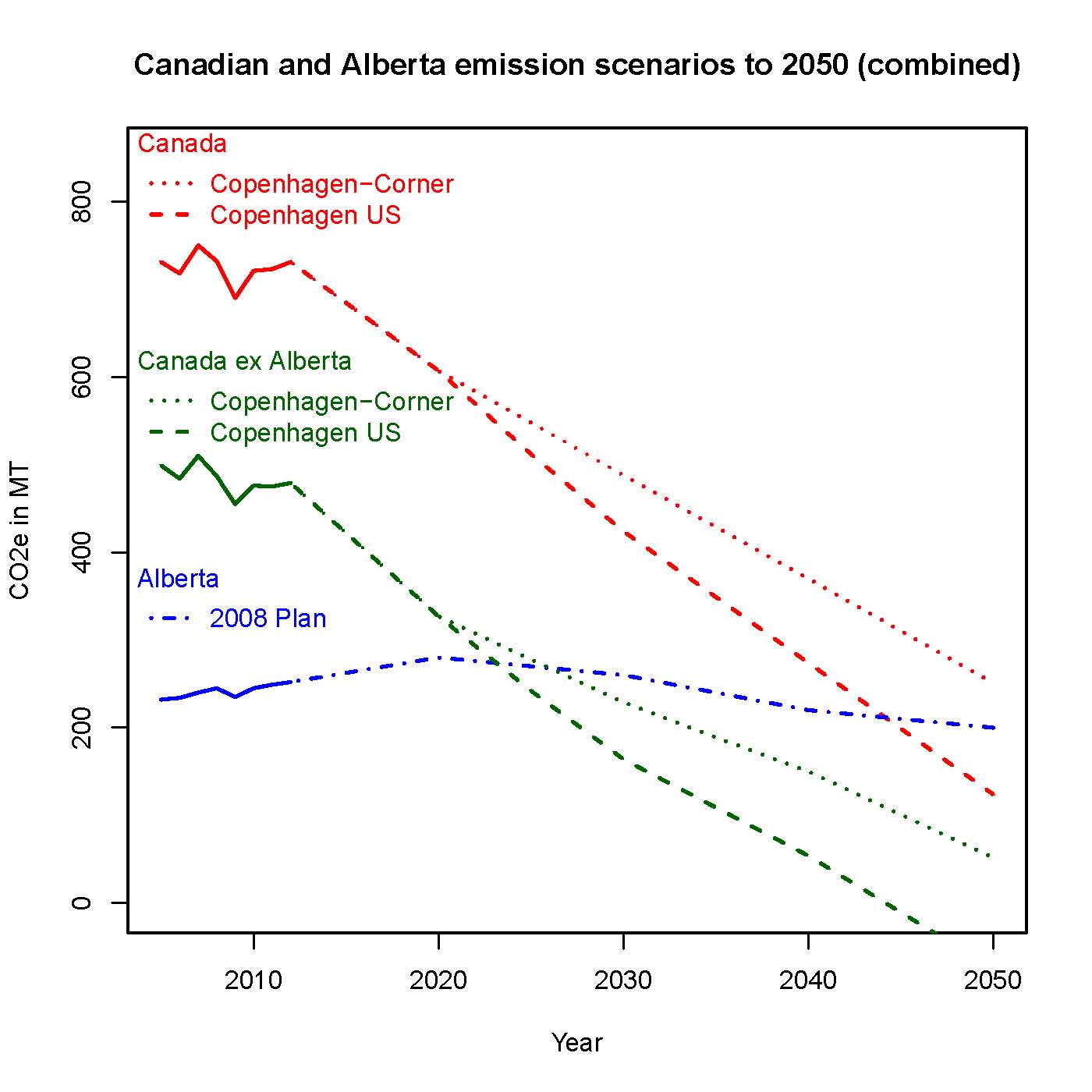
But I want to turn today to an analysis of the Conservative government’s putative  alternatives to Kyoto, namely the 2009 Copenhagen agreement, as well as the GHG reduction plans put forth in 2008 by Canada and the province Alberta (home to the oil sands and Conservative Prime Minister Stephen Harper).  That analysis confirms the contention of Jeffrey Simpson and others that the government of Canada is “mocking” the 2020 target agreed to only two years ago; the promised 17% reduction in annual GHG emissions (relative to 2005) is already out of reach. A big reason for this is an Alberta target (itself very unlikely to be met) that calls for a rise in GHG emissions until 2020. Not only that, but Alberta’s 2050 target, predicated on massive expansion of oil sands operations, is only 14% below 2005 levels, and sets Canada on a path that can not possibly be reconciled with the Harper government’s own stated long-term target, let alone any reasonable goal compatible with Canada’s responsibilities.

Continue reading

McKitrick hides the context

[UPDATE, Nov. 30:  I have added at the end a response from Ross McKitrick (originally posted as a comment at Judith Curry’s website), along with my additional commentary. Also the third paragraph has been slightly amended to clarify that the two out-of-context Phil Jones quotes, misleadingly juxtaposed and reversed by McKitrick, were originally three months apart.]

Son of climategate? SwiftHack 2.0? Dejavugate (as in “deja vu all over again”)? Whichever moniker one prefers for the latest release of stolen CRU emails, it is  very clear that a new round of out-of-context quote mining and error-filled “analysis” is already unfolding. And the leader out of the gate, so to speak, appears to be Ross McKitrick, whose recent National Post piece on the IPCC and the latest batch of stolen emails is now being spread far and wide.

In one particularly outrageous and error-filled passage, McKitrick accuses IPCC  AR4 co-ordinating lead authors Phil Jones and Kevin Trenberth of selecting their team of contributing authors solely on the basis of whether they agree with the pair’s scientific views. He even goes so far as to accuse Jones of “dismissing” (i.e. rejecting as a contributing author) one qualified expert who, supposedly in Jones’s own words, “has done a lot, but I don’t trust him.”

But the record clearly shows that it was Trenberth who made that last comment, and that he was expressing misgivings about the quality of the researcher’s work, not whether he was on the “right side” of scientific issues.  And the expert in question, climatologist Joel Norris, was in fact selected by Trenberth as a contributing author. Even worse, McKitrick has reversed the order of  the  Jones quotes (originally three months apart) , taken them out of context, and then juxtaposed them to make it appear as if they were part of the same exchange. Meanwhile, an examination of the two separate email discussions show chapter co-ordinators trying to fill out their team with authors who will be able to contribute effectively, in complete contradiction to McKitrick’s central thesis.

Continue reading

Open Thread # 11

There will be at least two new posts later this month. Meanwhile, the last Open Thread is getting a little long, so here’s a new one.

The Ethical Oil Institute on oil sands emissions

The illogical (not to mention deceitful) framing of Alberta oil sands development as a supposed choice between “ethical oil” and “conflict oil” continues to fall apart. In the latest fiasco playing out at Huffington Post Canada, Ben Amunwa, a prominent critic of Shell Oil’s environmental  record in Nigeria and the Alberta oil sands, has shredded EthicalOil.org spokesperson Kathryn Marshall’s ridiculous assertion that he is on the “same page” regarding the ethics of oil production (h/t Holly Stick).

So far, however, controversy has centred overwhelmingly on the distracting “ethical vs conflict oil” arguments and less on the equally misleading statements on the real environmental issues in the oil sands from EthicalOil.org (a.k.a. the Ethical Oil Institute). So today I’ll take a detailed look at the Ethical Oil position on the oil sands carbon footprint, as seen in former spokesperson Alykhan Velshi’s error-filled and confused post entitled Mythbusting: Are the Oilsands Major greenhouse Gas Emitters?, part of his “Myths and Lies” series.

I’ll focus on the two most significant problems in Velshi’s piece:

  • Velshi’s original premise was that not only are oil sands greenhouse gas (GHG) emissions relatively insignificant, but that they are actually declining. This has been partially corrected, presumably in response to my initial commentary on this issue, but in such a way as to render his argument completely illogical. And Velshi’s conclusion still repeats the utterly mistaken assertion that oil emissions “are falling”, whereas in fact they are rising at a rapid rate.
  • Ethical Oil’s credibility is further damaged by misleading statements concerning the supposedly tiny contribution of oil sands emissions when compared to total global human and natural emissions. This echoes barely veiled climate “skeptic” arguments in Ezra Levant’s 2009 book that started the whole “ethical oil” rebranding effort. And an examination of Levant’s previous statements on climate science would appear to confirm that a strong anti-science stance is not far from the surface, despite the efforts of Ethical Oil spokespersons to hide it.

Continue reading

Said and Wegman 2009: Suboptimal Scholarship

Today I present an analysis of a 2009 article by Yasmin Said and Edward Wegman of George Mason University. “Roadmap for Optimization” was published in the inaugural edition of WIREs Comp Stats, one of a new family of Wiley publications conceived as a “serial encyclopedia”. Wegman and Said, along with David Scott of Rice University, are also editors of the journal; the three are best known as co-authors of the 2006 “hockey stick” report to Congress, commissioned by Rep. Joe Barton.

As the title implies, the article was meant to provide a broad overview of  mathematical optimization and set the stage for subsequent articles detailing various optimization techniques. However my analysis, entitled Suboptimal Scholarship: Antecedents of Said and Wegman 2009, demonstrates the highly problematic scholarship of the “Roadmap” article.

  • No fewer than 15 likely online antecedent sources, all unattributed, have been identified, including 13 articles from Wikipedia and two others from Prof. Tom Ferguson and Wolfram MathWorld.
  • Numerous errors have been identified, apparently arising from mistranscription, faulty rewording, or omission of key information.
  • The scanty list of references appears to have been “carried along” from the unattributed antecedents; thus, these references may well constitute false citations.

First, I’ll present an abridged version of Suboptimal Scholarship summary as an overview of the analysis. Then I’ll take a look at a few examples showing the derivation of “Roadmap” from its antecedents, including some remarkable errors introduced in the process.  And finally I’ll place this latest embarrassment in the context of the pattern of dubious scholarship evidenced by Wegman and Said over the last several years.

Continue reading

The Institute

Here is part of a high-minded statement of purpose from a Canadian non-profit organization; see if you can guess which one.

The objects for which the Company is established are:
(a) To support and encourage research and education respecting the following:
(i) the use and development of natural resources including, without limitation, the extraction, production, development, conservation, protection, and distribution of natural resources, and other related matters, throughout Canada and the World;
(ii) conservation and protection of the environment;
(iii) ethical issues and considerations in respect of the items described in subparagraphs (i) and (ii) including, without limitation, issues and
considerations of environmental responsibility, peace, treatment of workers, democratic rights, and human rights;   ….

Suzuki Foundation? Nope. Well then, how about the energy think tank Pembina Institute? Wrong again, although this newer organization is also based in oil rich Alberta.

Say hello to – wait for it – the Ethical Oil Institute. Today I’ll take a first look at the hitherto unknown entity behind the latest push to defend the Alberta oil sands (a.k.a. tar sands). I’ll review the emerging roles of the Conservative-linked masterminds behind the initiative, namely pundit and author Ezra Levant and government spokesperson turned blogger Alykhan Velshi. And I’ll introduce Levant’s silent partner in the Institute: Calgary lawyer Thomas Ross,who also happens to be a partner at oil patch law firm McLellan Ross and one of the leaders of the firm’s OilSandsLaw.com initiative. All of this belies the studiously cultivated image of Ethical.org as a “grassroots” organizational effort; indeed, it looks more and more like industry sponsored  astroturf.

Continue reading

Mining new depths in scholarship, part 1

I examine the opening chapter by Edward Wegman and Jeffrey Solka in the 2005 Handbook of Statistics: Data Mining and Data Visualization (C Rao, E Wegman and J Solka, editors).  Sections 3 (The Computer Science Roots of Data mining ), 5 (Databases), 6.2 ( Clustering) and 6.3 (Artificial Neural Networks) appear to be largely derived from unattributed antecedents; these include online tutorials and presentations on data mining, SQL and artificial neural networks, as well as Brian Everitt’s classic Cluster Analysis. All the identified passages, tables and figures were adapted from “copy-paste” material in earlier course lectures by Wegman. The introduction to Chapter 13 (on genetic algorithms) by Yasmin Said also appears to contain lightly edited material from unattributed sources, including an online FAQ on evolutionary computing and a John Holland Scientific American piece. Several errors introduced by editing and rearrangement of the  material are identified, demonstrating the authors’ lack of familiarity  with these particular subject areas. This extends a pattern of problematic scholarship previously noted in the work of Wegman and Said.

Continue reading

Open Thread # 10

Possible topics for discussion:

… or anything else not on topic for recent threads.

Retraction of Said, Wegman et al 2008, part 2

Early climate contrarian reactions to the retraction of Said, Wegman et al 2008 have grasped at straws, holding that this does not affect the findings of the paper and the earlier Wegman report alleging inadequate peer review in climate science.

Now USA Today’s Dan Vergano, who broke the the retraction story, addresses exactly that contention in a follow up piece. Social network analysis expert Kathleen Carley of Carnegie Mellon calls Said et al “more of an opinion piece” that would have required “major revision” to render it fit for publication in an SNA journal.

And it gets worse. Computational Statistics and Data Analysis chief editor Stanley Azen “personally reviewed” the paper and sent Wegman an acceptance notice within days of submission.  Meanwhile, Virginia Tech’s Skip Garner enumerates the potential consequences of the research misconduct finding, including the possible need to investigate “ethical issues such as conflict-of-interest, haste vs. scientific rigor and bias”.

Continue reading