Category Archives: Climate science disinformation

Retraction of Said, Wegman et al 2008, part 1

It’s been a long time coming, but there has now been an official finding in at least one of the complaints concerning the dubious scholarship of GMU professors Edward Wegman and Yasmin Said. According to Dan Vergano of USA Today, the journal Computational Statistics and Data Analysis  (CSDA) has officially confirmed that Said, Wegman et al 2008, a follow up to the infamous Wegman et al report to Congress, will finally be retracted following complaints of plagiarism and inadequate peer review.

Continue reading

Wegman and Said 2011, part 2

I continue the previous discussion of  unacknowledged antecedents in  Color Theory and Design by Wegman and Said (WIREs Computational Statistics, 2011), and examine the second half of the article in detail. There is an excessive (and partially unattributed) reliance on Marc Green’s web page on the subject.  An analysis of the list of references and figures shows a disturbing failure of the authors (who are also two thirds of the editorial team) to follow WIREs own guidelines. In all, at least 10 of 17 references appear to be spurious, and 12 of  the 17 figures are not properly attributed. All told, there are at least 12 different identified sources of unattributed text and figures, including five Wikipedia articles. This pattern raises questions concerning the fitness of the authors for editorial duties.
Continue reading

Conservative Democracy Deficit on Vancouver Island

Green Party leader Elizabeth May attempts to make history on May 2, by winning in Saanich-Gulf Islands near Victoria and becoming Canada’s first Green MP. But the Victoria area has also been notable for the mysterious emergence of a plethora of supposedly independent “third party” advertisers supporting Conservative candidates in the closing days in each of the last two election campaigns in 2006 and 2008. The groups were mainly funded by Conservative contributors and their spouses, were facilitated by Conservative campaign managers, and used the local Conservative media planner, Treehouse Media. This overall pattern is evidence of possible collusion to circumvent Elections Canada campaign spending and contribution limits.

The battle between Green Party leader Elizabeth May and Conservative cabinet member Gary Lunn for the southern Vancouver Island riding of Saanich-Gulf Islands, just outside Victoria, is shaping up to be one of the  most hotly contested and closely watched races in the May 2 Canadian election. Not only is May seeking to make history as the Canada’s first ever Green MP, but the Victoria area has an interesting electoral story of its own.

Last time around in 2008, Lunn eked out a narrow victory over the Liberals’ Briony Penn, thanks in part to a shadowy network  of five local third-party advertisers that popped up to support Lunn on the last weekend of the campaign. Four of the five fly-by-night organizations shared the same financial agent and used the same contact address, which happened to be the  law office of Conservative riding association vice-president Bruce Hallsor. The resulting accusations of collusion to breach election spending limits have still not been resolved by Elections Canada.

Today, I’ll present new evidence about that case. It turns out that the tactic of dubious last-minute third-party advertising was first used in the neighbouring Victoria riding in the losing 2005-2006 election bid by Conservative Robin Baird. The links of the third parties to the Conservatives were, if anything, even more obvious – two of the ostensibly independent organizations showed involvement by contributors to Baird’s campaign, while the third was led by the wife of a local Conservative fund-raiser. Even worse, all three were apparently steered to the Conservatives’ regional media consultant, Steve Hutchinson of Treehouse Media, to co-ordinate creation and placement of advertising, a hitherto unnoticed pattern that was repeated in 2008. And in both 2006 and 2008, Conservative advertising was purchased up to the week before election, while the third parties took over all advertising spending after that date. Thus, there is now even clearer and more compelling evidence that these fictional “third parties” may be best understood as part of a Conservative initiative to fashion a last minute “push”, while circumventing election spending and contribution limits.

Continue reading

2011 Canadian election: The other debate

What a difference two-and-a-half years can make. Environmental issues were front and centre in the 2008 election, when the Liberal proposal of a carbon tax made climate change a key election issue. In contrast, last week’s televised leader debate was most notable for its key omissions: Green Party leader Elizabeth May was excluded this time round, while environmental issues barely rated a passing comment, let alone being raised as a topic of debate.

National CBC radio’s The Current attempted to rectify both of those gaping holes with a special broadcast on climate change. First, Elizabeth May was featured in a solo interview by Current host Annamaria Tremonti. Then a panel consisting of Conservative environment minister Peter Kent,  along with environment critics Gerard Kennedy of the Liberals and Linda Duncan of the NDP, took on a series of pointed questions about climate change policy.

Unsurpisingly, Kent repeated his false claims that Canada was on track to meet its 2020 greenhouse gas emission targets and claimed Conservative policies were having a noticeable effect. Even more outrageously, Kent claimed that a carbon tax would be an “irresponsible measure that would kill Canadian jobs” and intimated that European countries were backing away from programs to meet emission targets because of their effect on the economy, while glibly misrepresenting the Kyoto accord. And not only did he rule out cap-and-trade, but he refused to answer a point blank question about regulation of the oil and gas industry, preferring instead to extol the new oil sands water monitoring program announced just before the election.

Neither Kennedy and Duncan provided much detail on their parties’ respective cap-and-trade proposals, but both managed effective rebuttals to Kent, who sounded more than ever like the minister of the oil sands, not the environment.

Continue reading

Snapple on the Russian Connection

In several recent comments here, the blogger Snapple (Legend of Pine Ridge) has elucidated the indirect connections between Virginia Attorney-General Ken Cuccinelli Jr and Russian oil and gas interests. More recent comments focus on other aspects of the “Russian connection” with contrarian anti-science (see below).

Snapple’s previous comments on the activities of Ken Cuccinelli Sr can be found here and here (much of it overlapping with comments below), with more detail at this post at Legend of Pine Ridge . However, future comments on this subject should be made on this thread only.

Snapple’s recent comments follow.

Continue reading

John Mashey lecture tour: The Machinery of Climate Anti-Science

[Update, April 9-12: John Mashey’s presentation, entitled The Machinery of Climate Anti-Science, is now available at the Pacific Institute for Climate Solutions (PICS) website. The recorded video of Mashey’s presentation is also now available from PICS.

PICS is a multidiscplinary institute headed up by Executive Director Tom Pedersen, and is well worth checking out. You can start with the PICS Home Page and PICS at a glance. ]

As some of you know, computer scientist and tireless climate contrarian debunker John Mashey has been on a short lecture tour of B.C. (on the west coast of Canada). The tour culminates with a lecture tonight (Thursday, April 7) for the Pacific Institute for Climate Solutions at the University of Victoria.

Best of all (and the reason I wanted to post this), I’ve just found out the lecture will be streamed on the internet.The lecture starts at 7:30 PDT   (10:30 EDT). Go to:

http://www.pics.uvic.ca/broadcast.php

I’ll also post a link to John’s presentation when it’s available.  Here are the event details (which contain  a nod to yours truly).

Continue reading

Open Thread #9

Here are some possible topics:

  • Discussion (or lack of thereof) concerning climate change issues in the Canadian election campaign.
  • Steve McIntyre’s recent attacks on Keith Briffa and Tim Osborn, which also happen to contradict earlier allegations that IPCC TAR lead author Michael Mann took it on himself to “delete” or “chop off” data in a key “spaghetti” figure of paleoclimate reconstructions (allegations I had previously shown to be false).

And to start things off, I’ve redirected a comment by “George Mason” (presumably a pseodonym), who reminds us that one rogue professor and a lackadaisical and complaisant administration are not necessarily representative of George Mason University as a whole.

Wegman and Said 2011: Yet More Dubious Scholarship in Full Colour, part 1

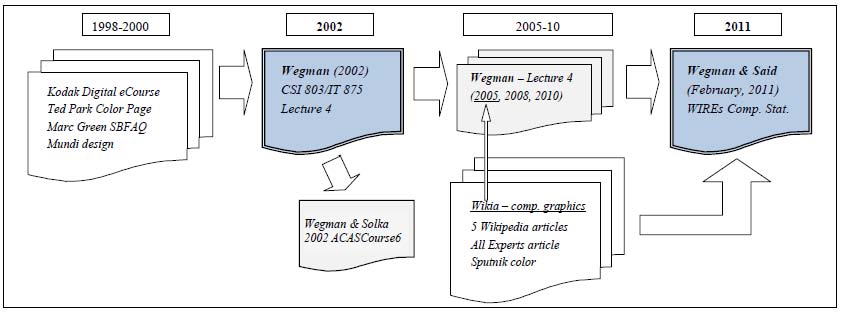
Previous posts have examined scholarship issues in the Wegman Report and  Wegman et al’s core flawed statistical analysis of the “hockey stick” graph. Now I show that a recent WIREs Computational Statistics overview article on colour theory and design by Edward Wegman and protege Yasmin Said is based mainly on unattributed “flow through” decade-old material from various websites. These have been augmented by further unattributed figures and text from current online sources, including five Wikipedia articles (see figure above right).

The first anniversary of “hockey stick” co-author Ray Bradley’s complaint against George Mason University statistics professor Edward Wegman has come and gone, but the ensuing proceeding at GMU shows no sign of resolution. Similarly absent is any indication of the release of code and data, promised by Wegman back in 2006, nor an explanation for the obvious problems permeating the Wegman Report’s core statistical analysis.

But through it all there has been one obvious question: if the Wegman Report and the follow up federally funded Said et al  on co-author social networks showed clear evidence of cut-and-paste scholarship, what might a close examination of other recent (or even not so recent) scholarship from the Wegman group reveal? To be sure, there already hints at the answer seen in problems in PhD dissertations from Said and others at GMU, and the insertion of a couple of paragraphs from the PhD dissertation of computer scientist David Grossman into a Wegman et al’s 1996 technical report.

A recent article by Wegman and Said in WIREs Computational Statistics opens up a whole new avenue of inquiry – and reveals a remarkable pattern of “flow through” cut-and-paste that goes even beyond Said et al 2008. Colour Design and Theory (published online in February) is based largely on a 2002 course lecture by Wegman. However, this is no case of simple recycling of material, for most of the earlier lecture material came from obscure websites on colour theory and was simply copied verbatim without attribution. Now much of it has shown up, virtually unchanged, nine years later. And the old material has been augmented with figures and text from several more decidedly non-scholarly sources, including – wait for it – five different Wikipedia articles.

Continue reading

Post Normal Meltdown in Lisbon, part 2

A world famous environmental journalist has just blogged about a workshop aimed at “reconciliation” between climate scientists and their critics. But hardly any actual scientists showed up, and now one of the missing invitees is complaining bitterly about the journalist’s “made up” coverage. The scientist’s been paraphrased as saying the “science is settled, so there’s nothing to discuss”, even though he’s on the record as rejecting such over-generalizations and binary thinking. In fact he’s noted that the IPCC reports themselves describe a “vast array of uncertainties”, but at the same time give rise to “well-supported concern that increasing emissions of CO2 (in particular) are posing a substantial risk to human society”. In addition, he objected to the very premise of the workshop, asserted the “conflict” was more rooted in politics than science, and suggested a search for common ground in policies having “co-benefits”.

Let’s listen in as editors valiantly struggle to set things right.

Continue reading

Post Normal Meltdown in Lisbon, part 1

[Update: Fred Pearce’s New Scientist article has been updated. More below]

It was all going so well. The climate contrarians, along with a handful of sympathetic scientists, had offered an olive branch of reconciliation to the climate science mainstream, discussed issues of common concern, and broken bread together. All this, in the salubrious environment of Lisbon and its Gulbenkian Foundation, facilitated by an experienced organizing group of “post-normal” science philosophers and the EU’s Joint Research Committee. The mainstream was noticeably absent, but there was the next best thing: the group’s favourite bete noir, Gavin Schmidt, had arrogantly refused to attend because, supposedly, the “science was settled and there was nothing to discuss”. Or so said New Scientist’s Fred Pearce who was there to capture this epochal moment for posterity.

Then it all went horribly wrong. It turned out that Schmidt had said nothing of the sort, and that Pearce had grossly misrepresented Schmidt’s email reply to organizers, which contained a polite, nuanced refusal, along with a list of subjects that should be discussed. This, even though Pearce had actually seen and read aloud the complete email [albeit accidentally truncated], which was leaked by “ad hoc” invitation committee member and fringe blogger “tallbloke” in what was (to put it charitably) a highly inappropriate attempt at spin. The gullible Pearce didn’t even bother to check with Schmidt, but appears to have accepted “tallbloke’s” version at face value.

But the naivete and gullibility do not end there, for Pearce missed the truly fascinating part of the whole story. “Tallbloke’s” passing around of the email he wasn’t even supposed to have was not just a supremely ironic coda to a workshop ostensibly dedicated to building trust and reconciliation (a circumstance which seems to have completely eluded the befuddled Pearce).  Somehow the fringe blogger and WUWT regular managed to forge a connection between  a highly respected science philosopher and the contrarian blogosphere, and then put himself in the inner circle planning the resulting workshop a year later, providing a fascinating insight into this misbegotten enterprise.

Continue reading