20-year surface trends close to models

Recently, I’ve been commenting to anyone who’ll listen (or not) that short-term comparisons of global temperature trends are not very meaningful and that at least the last 20 years should be analyzed. This was based on the seemingly paradoxical observation that, while trends from 2001 to present are down or flat, long term trends increased during the same period.

Finally someone (Lucia of Blackboard fame) has listened. Unfortunately, she has compared 20-year observed trends to a model subset that has an unrealistically high projected trend.

Continue reading

The Alberta oil boys network spins global warming into cooling

uah-polynomial-animationClick to view animation

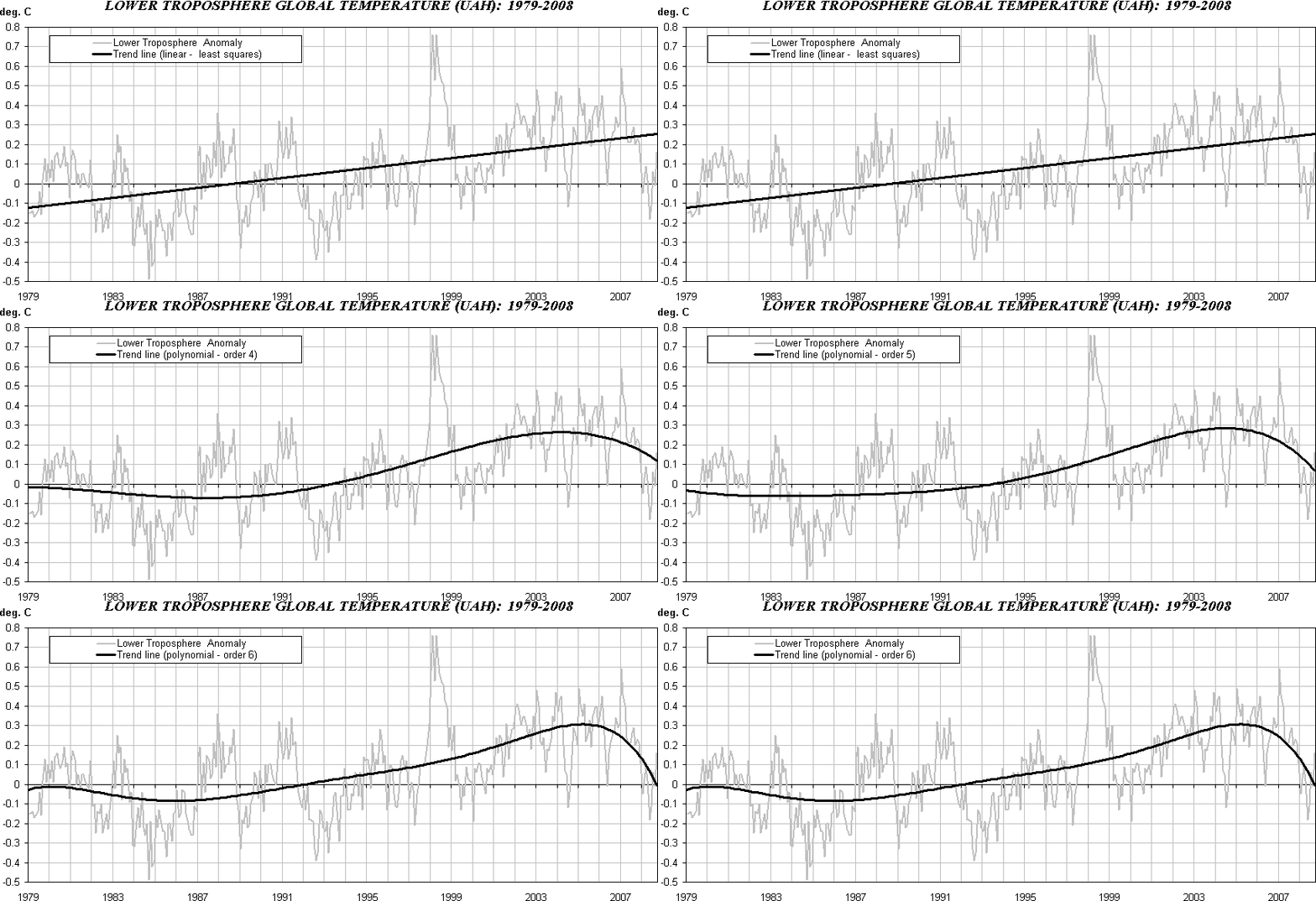
A new “analysis” craze has been sweeping the climate contrarian world of late. Not content with cherrypicking one relatively cool La Nina year (even though 2008 was still in the top 10 in the instrumental record), some of the usual suspects are now using higher-order polynomial fitting in an attempt to illustrate a severe downward “trend” in global temperature.

Chief among them (what a surprise) is Alberta’s very own “fact chucker”, National Post columnist Lorne Gunter (you read that right – LG will not rest until all facts are distorted or removed as seen in recent posts here and here). Roy Spencer (of UAH satellite-derived tropospheric temperature fame) has also jumped on the polynomial bandwagon, and now superimposes a polynomial curve on his monthly update of the UAH record. [Update May 15: Spencer no longer uses the fourth-order polynomial curve in his monthly update].  Can a “scientific” conference on the subject, perhaps jointly sponsored by the Heartland and Fraser institutes, be far behind?

Now it turns out that Gunter, who is mathematically challenged to say the least, has most likely been relying on the wisdom and Microsoft Excel skills of his fellow Albertan, oil industry insider and engineer Allan MacRae (or Allan M.R. MacRae, as he most often styles himself). MacRae is a minor but fast rising star in the contrarian firmament, as we shall see.

Continue reading

Seasonal divergence in tropospheric temperature trends, part 2

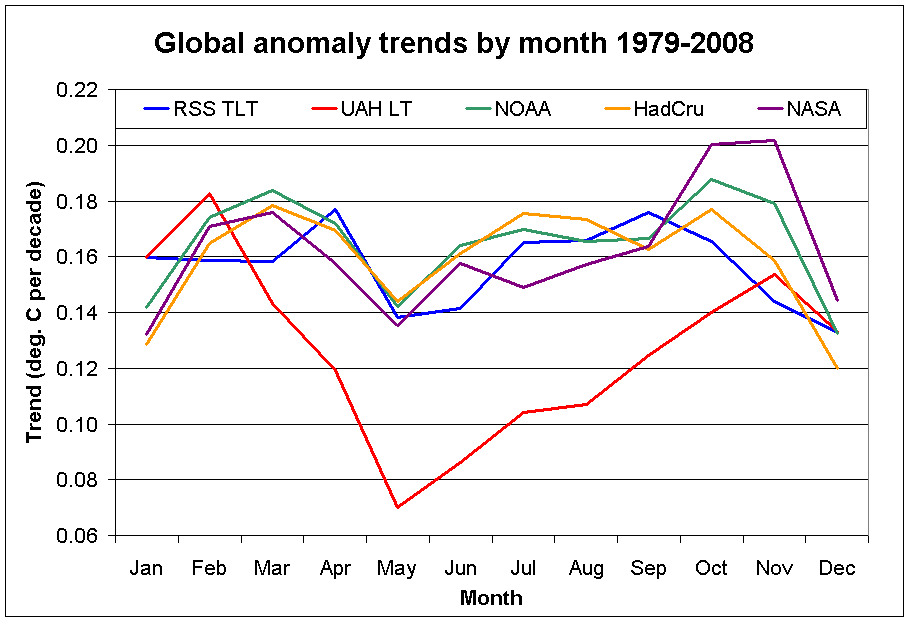
In a recent post, I examined seasonal divergence in troposphere temperature (LT) trends produced by teams at  RSS (Remote Sensing Systems) and UAH (University of Alabama at Huntsville). The strong annual cycle in the recent UAH data set has led to a wide divergence of temperature trends depending on time of year.

Since then, the blogosphere has been atwitter over the marked divergence between UAH and RSS for the month of February, which showed the UAH estimated anomaly (0.35) more than a full tenth of a degree higher than RSS (0.23).

Update (April 9, 2008): The March LT global temperature anomalies are out and they show both RSS (0.17) and UAH (0.21) down from February. The divergence has narrowed from 0.12 deg C in February to 0.04 deg C in March, which is exactly the divergence seen for that month in 2004-2008 (see below). So far in 2009, the UAH annual cycle is alive and well.

However, a detailed look at the divergence month-by-month shows that this latest discrepancy is not so surprising. I’ll also take a look at the effect on UAH of the recent switch to the newer AQUA satellite, which has actually resulted in an enhancement of  the UAH annual cycle. AQUA has a self-correcting propulsion system, so the UAH annual cycle, and the cyclic component of UAH-RSS divergence, can not be the result of differing methods of correction for diurnal drift resulting from orbital decay.

I start by showing the global temperature trends for each month for the 1979-2008 period for both LT and surface temperature sets.

global-month-trends1

Continue reading

Unthreaded #1

This is a general place for discussion climate science and climate science disinformation. Off-topic comments on specific threads may be reposted here (see the Comment Policy page for details on this and other policies).

Fact checking, National Post style: Lorne Gunter on global cooling (part 2)

When we last left LG, he’d managed to cram four or five howlers into the first paragraph of his latest National Post screed. Fearing the onset of RSI, I decided to take a break. But let’s resume …

Indeed, the drop in temperatures since late-2007 has been so precipitous –nearly a full degree Celsius– that almost all of the global warming that has occurred since the late-1970s has disappeared.

In fact, late 2007 looks cooler than the last month (January, 2009).

global-surface-2006-20083

Continue reading

Fact checking, National Post style: Lorne Gunter on global cooling (part 1)

In the wake of the kerfuffle concerning George Will’s column on sea ice in the Washington Post, Lorne Gunter has upped the ante in the Canadian daily newspaper National Post with a particularly error-ridden and nonsensical column on a favourite theme – the supposed “intellectual dishonesty” of climate scientists who refuse to accept the “fact” of “global cooling”.

A key issue in the Will case was the apparent failure of fact checkers and editors to catch what should have been obvious errors. Like Will, Gunter appears to lean on tidbits from such reliable sources as U.S. senator James Inhofe’s climate disinformation clearing house (run by aide Marc Morano), or blogs like Stephen Mcintyre’s Climateaudit.org or Anthony Watt’s Wattsupwiththat.com. Gunter then proceeds to somehow mangle even those dubious assertions.

Continue reading

Seasonal divergence in tropospheric temperature trends

msu-tlt-tropical-peak

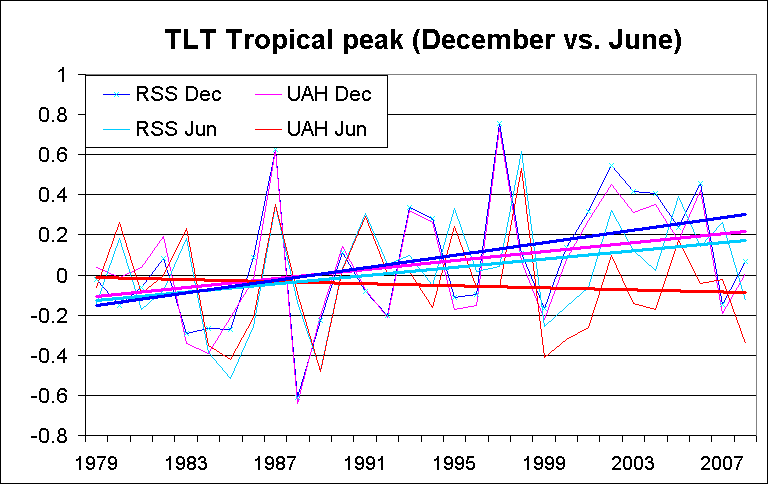
The two most commonly cited estimates of temperature in the troposphere based on satellite data are provided on an ongoing basis by Remote Sensing Systems (RSS) and University of Alabama at Huntsville (UAH). Last year, a strong annual cycle was identified in the UAH data by Atmoz and was examined in detail by Tamino at Open Mind here and here. In UAH, the annual cycle results in significantly higher anomalies at the beginning of the year (northern hemisphere winter) than in the middle of the year. And this pattern appears to be present in all latitude zones.

It seems reasonable that such a cycle would affect the observed trends over the 30-year period of the satellite temperature record. And indeed, it turns out there is a strong seasonal divergence; UAH trends for June-July-August (NH summer or JJA) are markedly lower than for December-January-February (NH winter or DJF). This strong seasonal divergence can be seen not only globally, but even in the tropics, as shown in detail below. This suggests that UAH trends lack physical realism, and should not be relied upon until the source of annual cycle problem is identified and fixed.

Continue reading

Canadians front and centre at 2nd Heartland Conference

Heartland Conference Logo - March 8-10, 2009

The “climate change skeptic” right-wing think tank Heartland Institute has been quietly updating its list of almost 60 speakers for the second annual International Conference on Climate Change to be held in New York this March – and Canadian skeptics are front and centre. And in at least two cases, the official affiliations listed for speakers appear unlikely to be bona fide.

Last year’s inaugural event was derided by climate scientists as a PR sham masquerading as a scientific conference. Conference speakers, most of whom are not practicing climate scientists, are paid a generous honorarium and all travel expenses. Funding sources are not disclosed, but the Heartland Institute has received $676,000 from ExxonMobil since 1998.

This year’s meeting will feature first time invitee Stephen McIntyre, founder of the popular ClimateAudit blog, as one of six headliners. McIntyre is described by Heartland as a “devastating critic of the temperature record of the past 1,000 years”, but has published only one peer-reviewed article in a recognized science journal.

Interestingly, McIntyre’s listed affiliation is with the University of Toronto. McIntyre’s connection to the University is unclear, although he does apparently have a University email address.

Among the other five confirmed Canadian speakers, undoubtedly the most controversial is Lawrence Solomon, listed as affiliated with the National Post, a national Canadian daily newspaper. Solomon is the author of The Deniers, a book based on a long series of individual profiles written for the Post. He has recently launched attacks in the Post on Michael Mann, director of the Earth System Science Center at Penn State University, as seen  here and here. Solomon is executive director of Energy Probe, a non-profit group that “works for  environmental sustainability by promoting property rights.” (Closer scrutiny of this group  is clearly warranted, but will have to wait for a future post).

Continue reading

Hello World!

Welcome to Deep Climate, an exploration of the climate science “skeptic” movement in Canada. In the coming weeks and months, I’ll be looking at the organizations that propagate climate science disinformation and the public relations professionals who have worked behind the scenes to ensure maximum impact of that disinformation. I intend both to “follow the money” (flowing primarily from special interests opposed to regulation or taxation of greenhouse gas emissions) and to “follow the science” (by exposing the most egregious flaws in the “evidence” against the attribution of contemporary climate change primarily to human causes). From time to time, I’ll also “follow the politics” and examine the various ties between the “skeptic” movement and the Conservative Party of Canada.

The four most prominent climate science disinformation organizations in Canada are:

Continue reading