Author Archives: Deep Climate

Open Thread #9

Here are some possible topics:

  • Discussion (or lack of thereof) concerning climate change issues in the Canadian election campaign.
  • Steve McIntyre’s recent attacks on Keith Briffa and Tim Osborn, which also happen to contradict earlier allegations that IPCC TAR lead author Michael Mann took it on himself to “delete” or “chop off” data in a key “spaghetti” figure of paleoclimate reconstructions (allegations I had previously shown to be false).

And to start things off, I’ve redirected a comment by “George Mason” (presumably a pseodonym), who reminds us that one rogue professor and a lackadaisical and complaisant administration are not necessarily representative of George Mason University as a whole.

Wegman and Said 2011: Yet More Dubious Scholarship in Full Colour, part 1

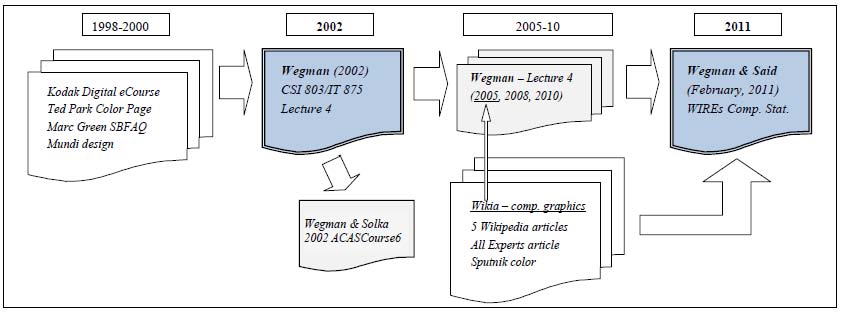
Previous posts have examined scholarship issues in the Wegman Report and  Wegman et al’s core flawed statistical analysis of the “hockey stick” graph. Now I show that a recent WIREs Computational Statistics overview article on colour theory and design by Edward Wegman and protege Yasmin Said is based mainly on unattributed “flow through” decade-old material from various websites. These have been augmented by further unattributed figures and text from current online sources, including five Wikipedia articles (see figure above right).

The first anniversary of “hockey stick” co-author Ray Bradley’s complaint against George Mason University statistics professor Edward Wegman has come and gone, but the ensuing proceeding at GMU shows no sign of resolution. Similarly absent is any indication of the release of code and data, promised by Wegman back in 2006, nor an explanation for the obvious problems permeating the Wegman Report’s core statistical analysis.

But through it all there has been one obvious question: if the Wegman Report and the follow up federally funded Said et al  on co-author social networks showed clear evidence of cut-and-paste scholarship, what might a close examination of other recent (or even not so recent) scholarship from the Wegman group reveal? To be sure, there already hints at the answer seen in problems in PhD dissertations from Said and others at GMU, and the insertion of a couple of paragraphs from the PhD dissertation of computer scientist David Grossman into a Wegman et al’s 1996 technical report.

A recent article by Wegman and Said in WIREs Computational Statistics opens up a whole new avenue of inquiry – and reveals a remarkable pattern of “flow through” cut-and-paste that goes even beyond Said et al 2008. Colour Design and Theory (published online in February) is based largely on a 2002 course lecture by Wegman. However, this is no case of simple recycling of material, for most of the earlier lecture material came from obscure websites on colour theory and was simply copied verbatim without attribution. Now much of it has shown up, virtually unchanged, nine years later. And the old material has been augmented with figures and text from several more decidedly non-scholarly sources, including – wait for it – five different Wikipedia articles.

Continue reading

Post Normal Meltdown in Lisbon, part 2

A world famous environmental journalist has just blogged about a workshop aimed at “reconciliation” between climate scientists and their critics. But hardly any actual scientists showed up, and now one of the missing invitees is complaining bitterly about the journalist’s “made up” coverage. The scientist’s been paraphrased as saying the “science is settled, so there’s nothing to discuss”, even though he’s on the record as rejecting such over-generalizations and binary thinking. In fact he’s noted that the IPCC reports themselves describe a “vast array of uncertainties”, but at the same time give rise to “well-supported concern that increasing emissions of CO2 (in particular) are posing a substantial risk to human society”. In addition, he objected to the very premise of the workshop, asserted the “conflict” was more rooted in politics than science, and suggested a search for common ground in policies having “co-benefits”.

Let’s listen in as editors valiantly struggle to set things right.

Continue reading

Post Normal Meltdown in Lisbon, part 1

[Update: Fred Pearce’s New Scientist article has been updated. More below]

It was all going so well. The climate contrarians, along with a handful of sympathetic scientists, had offered an olive branch of reconciliation to the climate science mainstream, discussed issues of common concern, and broken bread together. All this, in the salubrious environment of Lisbon and its Gulbenkian Foundation, facilitated by an experienced organizing group of “post-normal” science philosophers and the EU’s Joint Research Committee. The mainstream was noticeably absent, but there was the next best thing: the group’s favourite bete noir, Gavin Schmidt, had arrogantly refused to attend because, supposedly, the “science was settled and there was nothing to discuss”. Or so said New Scientist’s Fred Pearce who was there to capture this epochal moment for posterity.

Then it all went horribly wrong. It turned out that Schmidt had said nothing of the sort, and that Pearce had grossly misrepresented Schmidt’s email reply to organizers, which contained a polite, nuanced refusal, along with a list of subjects that should be discussed. This, even though Pearce had actually seen and read aloud the complete email [albeit accidentally truncated], which was leaked by “ad hoc” invitation committee member and fringe blogger “tallbloke” in what was (to put it charitably) a highly inappropriate attempt at spin. The gullible Pearce didn’t even bother to check with Schmidt, but appears to have accepted “tallbloke’s” version at face value.

But the naivete and gullibility do not end there, for Pearce missed the truly fascinating part of the whole story. “Tallbloke’s” passing around of the email he wasn’t even supposed to have was not just a supremely ironic coda to a workshop ostensibly dedicated to building trust and reconciliation (a circumstance which seems to have completely eluded the befuddled Pearce).  Somehow the fringe blogger and WUWT regular managed to forge a connection between  a highly respected science philosopher and the contrarian blogosphere, and then put himself in the inner circle planning the resulting workshop a year later, providing a fascinating insight into this misbegotten enterprise.

Continue reading

Open Thread #8

I’m working on two or three projects that are taking a little more time than I would like. But in the mean time, here’s a new thread for open discussion of climate science and related matters not discussed in other recent threads.

Another “climategate” whopper from McIntyre

By Deep Climate

There’s been quite a stir about NCAR Senior Scientist Kevin Trenberth and his upcoming presentation at the American Meteorological Society Annual Meeting. Some of that spilled over here in a spirited discussion of Trenberth’s failure to blockquote a cited paper by Hasselmann (there has since been a new version which appears to be a sincere if hasty fix). The original controversy, though, largely centered on Trenberth’s withering attack on the climate science contrarians and his characterization of them as “deniers” and “charlatans”, which, needless to say, has caused howls of outrage throughout the contrarian blogosphere.

No one has been more outraged by Trenberth’s broadside than Steve McIntyre, who decided to bring what Judith Curry called a “historical perspective” and revisited a “climategate” controversy about “keeping papers out” of IPCC AR4. McIntyre dismissed Trenberth’s defence of Phil Jones as a “first time IPCC writing team member” as “readily demonstrated to be untrue”. McIntyre’s ironclad proof? Despite Trenberth’s claim of being an IPCC “veteran”, both Trenberth and Jones had exactly the same IPCC resume as Chapter 2 contributing authors for the Second and the Third Assessment Reports, before becoming lead authors together in AR4.

I’m sure regular Deep Climate readers will be shocked – just shocked – to find out that a closer look behind McIntyre’s selective facts tells a completely different story. Trenberth was clearly referring to experience as a lead author (contributing authors are not on the “writing team”). And both Jones and Trenberth may have been Chapter 2 contributing authors on previous IPCC reports, but Trenberth was also both a Chapter and Technical Summary Lead Author  in both 1995 and 2001. So, once again, the latest “climategate” scandal proves to be yet another outright falsehood from McIntyre.

Continue reading

Ethical Oil

“The world needs more Canada” is a favourite saying among Canadians (not to mention U2’s Bono). But there are days I’m not so sure. And today is one of those days.

Say hello to so-called  “ethical oil”. And goodbye to any remnant of Canadian government respectability on the world stage, at least as far as environmental issues are concerned.

This week, newly minted environment minister Peter Kent took the opportunity of a full-length interview on CBC to launch a vigourous defence of the Alberta oil sands, regarded by many as one of the the most environmentally destructive mega-projects in the world. Piling falsehood upon falsehood, Kent claimed:

  • Canada is on track to meet its greenhouse gas emissions target of 17% reduction from 2005 levels by 202o.
  • Reductions so far have been due to “technology improvement” (with the oil sands as the sole example cited).
  • Any contamination of the Athabasca River is natural and there is “absolutely no scientific evidence” of elevated contaminant levels from oil sands operations, specifically referring to leakage from tailings ponds. Renowned ecologist David Schindler is flat-out “wrong” to assert otherwise.

And then Kent unleashed his “ethical oil” talking point (one that originates with far right columnist Ezra Levant). Not only are the oil sands subject to “environmental control and oversight”, but Americans should be reassured that revenues “don’t go to fund terrorism or the destabilization of other governments”.

All of which leads to the obvious question asked by flabbergasted CBC host Evan Solomon: “Is your job to protect the oil sands or is it your job to protect the environment?”

Continue reading

Wegman on Deep Climate (and “climategate”)

John Mashey has released an updated version of Strange Investigations at George Mason University [SIGMU PDF at DeSmogBlog], which tells the story of GMU’s slow-as-molasses misconduct  inquiry of Edward Wegman through various email exchanges between paleoclimatologist Raymond Bradley and GMU. Mashey now includes correspondence involving one Donald Rapp, retired engineer/physicist turned climate contrarian author. Rapp has been complaining far and wide about the indignity of plagiarism complaints lodged at the University of Southern California and at his publisher Praxis/Springer, even going so far as to exhort USA Today reporter Dan Vergano to spread one email exchange “all over the internet”.

All this will no doubt prove fascinating reading and provide fodder for weeks to come, as it has in the past. (Highlight from early 2009: “But the donkeys on deepclimate.org are the Taliban of climate change – and just as dangerous”). But for now I want to focus on two emails from Wegman himself, both forwarded by Rapp. Wegman has some choice comments about the “totally unsavory” blog of yours truly, claiming it to be – wait for it – “developed in retaliation” for enquiries into the “obvious misconduct made clear” by climategate.  But the problem is not just some obscure Canadian blogger; according to Wegman, even Bradley’s complaint to GMU itself is nothing more than “a smear campaign that attempts to deflect scrutiny from the real misconduct revealed by the climategate emails”.

When the story of the Wegman misconduct inquiry first broke in USA Today, Wegman plaintively protested “We are not the bad guys”, leaving one to wonder just who the “bad guys” might be, at least in Wegman’s fevered imagination.  Now, we have the answer in Wegman’s latest outrageous and unsubstantiated accusations against climate scientists.

Continue reading

Looking back and looking forward

By Deep Climate

Given the time of year, and with a spiffy report from WordPress on Deep Climate sitting in my mailbox, this seems as good a time as any to take stock as well as talk a little bit about what’s coming up in 2011.

Continue reading

George Mason University’s endless inquiry

By Deep Climate

A year ago, I first identified scholarship issues in the 2006 Wegman report, the contrarian touchstone commissioned by Republican congressman Joe Barton as part of his concerted campaign to discredit the “hockey stick” temperature reconstruction and the scientists behind it, especially Michael Mann. (The report was produced by lead author George Mason University statistics professor Edward Wegman, along with co-authors Rice University professor David Scott and Wegman protégé Yasmin Said, although Scott seems to have had little to do with it).  Eventually, I demonstrated apparent plagiarism in 10 pages of background sections in the report, as well as in an obscure (but federally funded) follow-up article by Said, Wegman and two other Wegman acolytes. At the time, it seemed a matter of interest only in the blogosphere, while the mainstream media ignored the issue in favour of the bogus “climategate” scandal.

But it turned out that my work had come to the attention of at least one important player in this drama – paleoclimatologist and “hockey stick” co-author Raymond Bradley. Back in March, Bradley quietly filed an initial complaint with GMU alleging plagiarism by Wegman et al of Bradley’s own work, attaching some of my initial analysis. Two months later, Bradley updated GMU with my further evidence of more “widespread” plagiarism, including wholesale copying of passages from two social network text books and Wikipedia, in both the Wegman report itself, and the follow-up 2008  article by Said et al. Bradley also took special care to point out the discovery of federal funding for the latter, which made the apparent breaches of misconduct policy all the more serious.

None of this was known until the ever patient Bradley went public, notably in recent statements in online and print articles by USA Today science reporter Dan Vergano. Now, a comprehensive report by John Mashey, based on the complete communication between Bradley and GMU research vice president Roger Stough, along with an analysis of GMU’s academic misconduct policy, shows exactly why Bradley finally came forward. Strange Investigations at George Mason University [PDF 2.6 Mb ], presents a shocking picture of foot-dragging and lack of transparency at GMU. Despite the copious evidence presented by Bradley, no substantive action ensued until the belated August convening of the inquiry committee. That committee was supposed to have reported within 60 days of its ostensible nomination in April, and had only to consider the limited question of whether the allegations were substantive enough to warrant a full-blown investigation. Yet even the committee’s belated start only came after the intervention of Elsevier environmental sciences publisher John Fedor. Even worse, GMU’s Stough failed to provide promised progress reports, and the inquiry committee missed Stough’s stated September 30 deadline for delivery of its report. And Stough’s last substantive response in October to Bradley vaguely referred to needing “a few weeks more” to wrap up the inquiry phase, while since then he has stonewalled all further requests for updates.

So more than nine long months after Bradley’s initial complaint, GMU has yet to clearly reach the end of its initial inquiry, a phase that should have been pursued rigorously and resolved easily within GMU’s own timelines. That is especially so given the compelling evidence and the impetus of the serious issue of federal funding, which normally requires resolution of a misconduct inquiry within 60 days as a matter of law. All of this calls into serious question GMU’s misconduct policy and process, and indeed the university’s very commitment to fundamental principles of academic integrity.

Continue reading